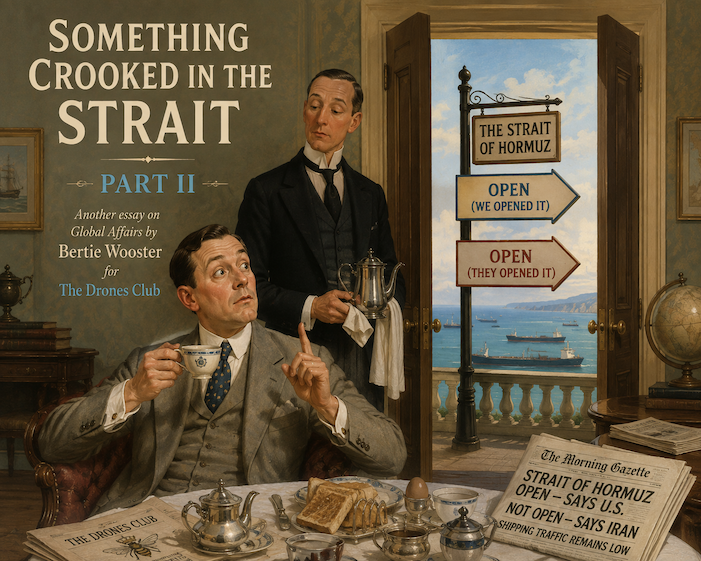
Jeeves had made what I thought was a rather interesting observation the previous day, although, at the time, I had not paid it the attention it deserved because Tuppy Glossop, who had invited himself to lunch, was in the midst of a longish story about a horse, a bishop and a girl in Eastbourne and one does not like to appear inattentive when a fellow has gone to the trouble of getting all the way to Eastbourne.
It was something about doors. Jeeves had suggested that the Strait of Hormuz was like a door which, at the time, I had thought to be a rather elaborate consideration.
“You see, Jeeves,” I said over breakfast the following morning, the newspaper having informed me that the Strait of Hormuz was open again, except that Iran still said it wasn’t, while America said it was and, indeed, fully under American control, although the number of ships actually passing through it seemed to suggest that the Strait had yet to receive the memo, “I can’t quite get my head around this Strait business. It’s open, except when it isn’t and when it isn’t, everybody is terribly keen that it should be, except that nobody wants to be the first to admit that he wants it open. Reminds me rather of young Freddie Widgeon and that business with his cousin’s cousin…”
“A similar reluctance to concede a point, sir?”
“ Exactly. Freddie had promised never to go back to speak to that girl again, but spent three weeks hanging around outside her house waiting for her to emerge and speak to him!”
“A distinction of some importance, sir.”
“Yes. He hadn’t gone back. He’d just hung around in the vicinity.”
“A man of his word, Mr. Widgeon.”
“And that’s what these chaps are doing. No one’s agreeing to open the Strait but they are all hanging around waiting for somebody else to agree first.”
“You have identified the difficulty precisely, sir.”
“By Jove, Jeeves, I see it now. This isn’t really about the Strait at all. It’s about ego. Nobody wants to be the first chap to climb down. Like Aunt Agatha.”
“Indeed, sir.”
“She could maintain a grudge for years without remembering what it was about.”
“A formidable accomplishment, sir.”
“And if anyone suggested she might have overreacted, she’d say it wasn’t the point.”
“I believe that was precisely the point, sir.”
I began to wonder whether Jeeves hadn’t been onto something when he drew that analogy between the Strait of Hormuz and a door.
“You know, Jeeves, about that door you mentioned yesterday. I’ve been thinking about it.”
“Yes, sir.”
“I suppose there are really two sorts of doors. There is the ordinary door, which you open when you want to go through it and there is the rather more complicated sort, where the fellow on the other side decides whether it is open or shut.”
“An important distinction, sir.”
“Exactly. And then there is the swing door.”
“Yes, sir.”
“Which is where things become even more complicated. Because if it swings both ways; the fellow on either side can push it open and say, quite truthfully, that he opened it. The fellow on the other side can say precisely the same thing, and before you know where you are, the door has become a matter of principle.”
“Principles can complicate otherwise simple arrangements, sir.”
“That’s what I thought.”
I sat back and considered the matter.
The trouble, as far as I could make out, was that everybody wanted the Strait open, but nobody, particularly, wanted to be the fellow to admit having opened it. It reminded me of a rather unfortunate dinner at Brinkley Court when two chaps had quarrelled over who had invited whom.
It began, as these things often do, with neither man wanting to admit that he particularly wished the other to stay. The first fellow said he hadn’t invited the second. The second said he hadn’t come because he’d been invited. The first said that having come, he was perfectly welcome to remain. The second said he had no intention of remaining where he wasn’t wanted.
After forty minutes they were both sitting at the dinner table eating Anatole’s soufflé while maintaining that neither had intended to stay in the first place.
Jeeves had the grace not to comment. This was perhaps just as well, because I was beginning to see the point.
“It isn’t really about getting through the door, Jeeves. It’s about making sure that nobody thinks you were the chap who opened it.”
“Appearances can be important, sir.”
“Exactly. You could open the door and still insist that you hadn’t opened it. You’d merely permitted circumstances to make an opening available.”
“Appearances can also be deceptive, sir.”
“And if the other fellow walked through it, you could say you hadn’t invited him.”
“Quite so, sir.”
“While he could say that he hadn’t been forced through it.”
“Indeed sir.”
I looked at the newspaper again.
There was, I thought, something almost reassuring about it. The whole business was beginning to resemble Aunt Agatha, who could forgive a man almost anything except winning an argument, because victory on his part necessarily implied that she had lost and there are certain ladies for whom losing an argument is considerably more offensive than being wrong.
She once spent an entire luncheon explaining that she had not changed her mind about something. Nobody had suggested that she did. This, naturally, made everybody certain that she had.
“Jeeves, I think I’ve got it.”
“I am gratified to hear it, sir.”
“Once you’ve announced a principle, you can’t abandon it without appearing to have abandoned it.”
“An awkward predicament, sir.”
“Which means you have to discover some entirely different reason for doing the thing you wanted to do all along.”
“A useful expedient, sir.”
“Precisely. You don’t open the door because the other fellow has won. You open it because, on reflection, the door was never really closed.”
“An interesting distinction, sir.”
“Not merely interesting. Essential.”
I was warming to the subject now.
A fellow could maintain that he had never yielded an inch while standing six feet further back than he had been standing the previous afternoon. He could say that he had not withdrawn a demand but merely reconsidered the circumstances in which the demand might appropriately be pursued. He could even say that talks had not resumed because, strictly speaking, they had never ended.
That last one particularly appealed to me.
“Jeeves, if a fellow says he hasn’t gone back to the negotiating table because he never left it, does that mean he has gone back?”
“I would hesitate to say, sir.”
“Why?”
“Because, sir, it might depend upon whether he had actually left.”
“Ah.”
I considered this for a moment.
“Because if he’d only said he was leaving, but had remained sitting at the table, then technically, he hasn’t returned at all.”
“Technically, sir.”
“By Jove.”
I felt that familiar sensation of having grasped something important.
The whole business of diplomacy, I thought, might be nothing more than a gentleman arranging matters so that he can do what he wants without having to admit that he wants to do it.
Like Bingo. Like Aunt Agatha. Like Tuppy. Like practically every married man I had ever met.
And, when one thought about it, like me.
There was that unfortunate occasion when I announced to a certain young lady that I would never darken her door again, only to discover twenty minutes later that I had left my specially monogrammed cigarette case in her sitting room, one particularly close to my heart. I returned for it. But it was not a return. It was a retrieval.
The distinction had seemed perfectly satisfactory at the time.
I looked once more at the newspaper.
“You know, Jeeves, I think we may have been looking at the wrong part of the problem.”
“I believe that may be so, sir.”
“It isn’t really about whether the door is open. It’s about who gets to say he opened it.”
“That would appear to be a significant consideration, sir.”
I sat back and, suddenly, I saw it.
“By Jove, Jeeves. The door swings both ways!”
“Precisely, sir.”
“Which means the fellow on either side can claim he opened it.”
“Indeed, sir.”
“And neither has to admit that the other fellow did.”
“Quite so, sir.”
I considered this triumph of statesmanship for a moment.
“Jeeves?”
“Sir?”
“I believe I’ve just straightened the Strait.”
“Very good, sir.”
And, having settled a long-pending global issue before breakfast, I decided that civilisation could safely be left to get on with the rest of the day.
[A loving and respectful homage to Plum]