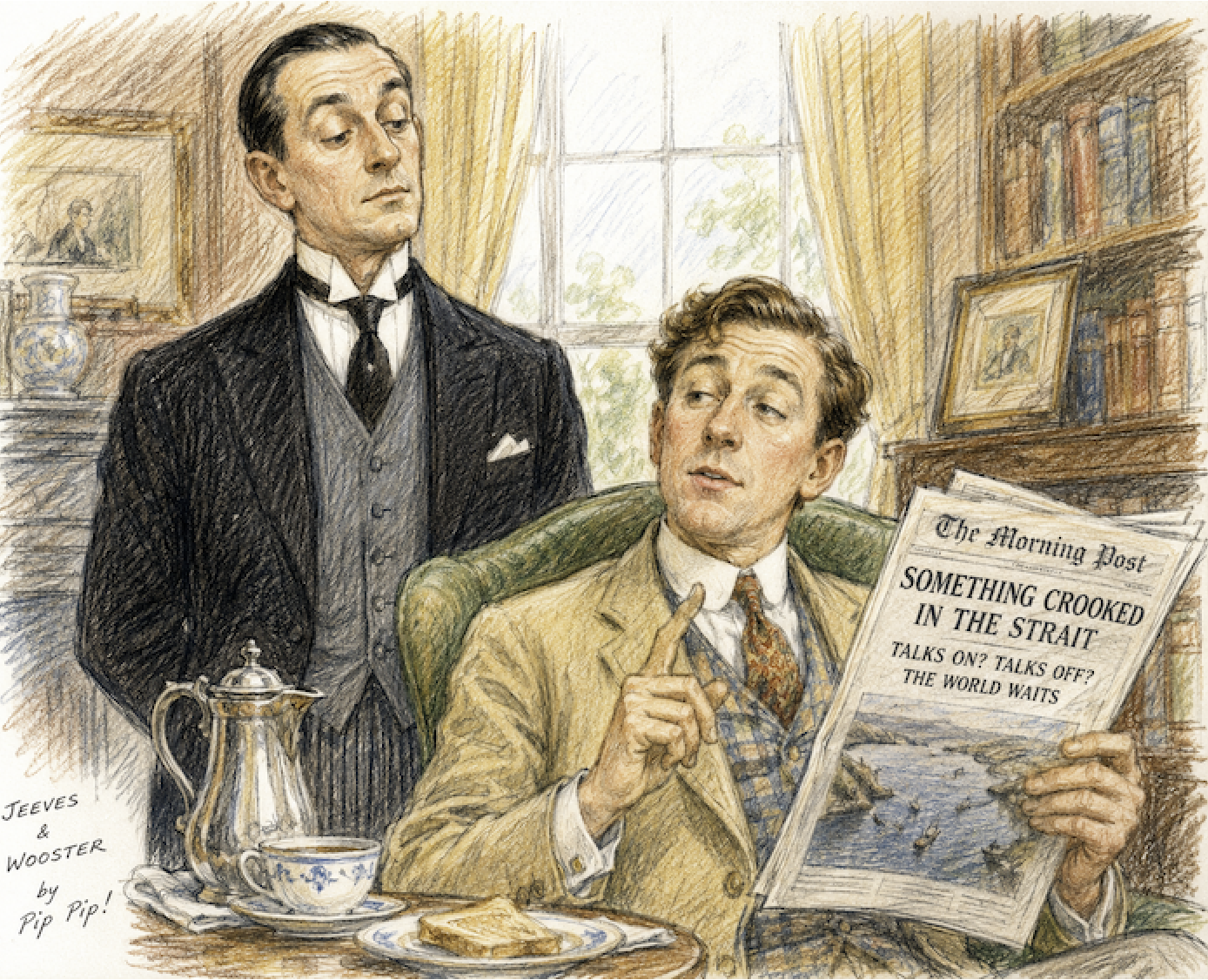
“Jeeves,” I said, lowering the morning paper, “there appears to be something crooked in the Strait.”
“Indeed, sir?”
“The Strait of Hormuz, I mean. The Americans want it open. The Iranians want it closed. When the Americans threaten dire consequences, they open some of it, to close the whole dashed thing all over again just when the cove in Washington begins to think he’s had his way. A bit like the mouse baiting the cat, if you know what I mean. The tail wagging the dog.”
“I apprehend your meaning, sir.”
“Precisely. This Washington chappie, having previously taken a fairly muscular interest in the Iranian question, now wishes to talk peace, provided the Iranians first come along and ask him to. Politely, preferably on bended knee, if the morning papers have got the thing straight.”
“A somewhat exacting posture for negotiation, sir.”
“Particularly if the negotiations run long. Plays merry hell with the patellae.”
“Undoubtedly, sir.”
I returned to the paper, but the news did not improve on further acquaintance. There are mornings when a fellow feels that Providence has arranged matters with unusual consideration: the bacon behaves itself, the coffee displays the old collegiate spirit, the toast comes through crisp without exhibiting that tendency to carbonise at the edges, which has soured many a promising day and one begins to think that civilisation, though perhaps not an unqualified success, is at least making a sporting effort.
Then one reads the newspapers.
“The thing I don’t understand, Jeeves, is whether these fellows are talking or not talking.”
“There appears to be some uncertainty on that point, sir.”
“That’s putting it mildly. One headline says talks are off. Another says they’re on if conditions are met. A third says back-channel discussions continue. A fourth says there are no back-channel discussions at all, though unnamed sources familiar with the matter appear to know what was said at them even when they never happened. And meanwhile, everybody is issuing statements saying that the door remains open while taking dashed good care that nobody actually walks through it.”
“A familiar diplomatic convention, sir.”
“It reminds me of Bingo Little.”
“Indeed, sir?”
“You remember his romantic career?”
“Vividly, sir.”
“Every fortnight Bingo would appear at the Drones announcing that the thing was over. Absolutely over. No possibility of reconciliation. A clean break. The woman in question was, henceforth, dead to him and he to her. One would buy the poor fish a restorative, speak feelingly about there being other pebbles on the beach and, by teatime, discover that the recently estranged pair had become engaged.”
“Mr Little was notably resilient in matters of the heart, sir.”
“Resilient? The man’s emotional life was a revolving door.”
I studied the photograph accompanying the article.
“What seems to be required here, Jeeves, is that everybody should return to the negotiating table while maintaining that he has done nothing of the sort.”
“Appearances are often considered important, sir.”
“That’s it! Nobody objects to changing his mind. What he objects to is anybody noticing that he has.”
“An understandable sensitivity.”
And there, I suddenly perceived, was the nub, crux and essential “whatsit” of the whole affair.
There are few spectacles more affecting than that of a gentleman attempting to leave a room with dignity after loudly announcing that he has no intention of returning. If he genuinely means to go, there is no difficulty. He collects his hat, says good evening and goes. The trouble begins when he wishes to be pursued.
Aunt Agatha was a recognised authority on this manoeuvre. She could leave a drawing room with the finality of the British evacuating Dunkirk, yet somehow contrive to reach the front door slowly enough for somebody to catch up and apologise. On occasions, when nobody did, she would remember an umbrella.
The great thing was that her return was never to be construed as a return. She had merely come back for the umbrella. That she then remained another forty-five minutes demolishing the opposition was beside the point.
“By Jove, Jeeves! That’s what they’re doing.”
“Sir?”
“The umbrella.”
“Ah.”
“Everybody wants to come back into the room, but nobody can afford to be seen coming back into the room. So what is needed is an umbrella.”
“A face-saving device, sir.”
“Exactly. The Washington fellow says he’s perfectly willing to talk, but only if Tehran makes the first move. Tehran says it isn’t making the first move because Washington started the dashed rumpus in the first place. Everyone wants peace but nobody wants it badly enough to be caught asking for it.”
“Pride can be an expensive luxury, sir.”
I looked at him sharply.
“Jeeves, you’ve summed up several thousand years of human history in six words.”
“I fear the observation is not original, sir.”
“Never mind originality. Accuracy is the thing.”
I returned to the paper and considered the matter.
“If only the cove in Washington were more like Aunt Agatha.”
“In what respect, sir?”
“Had an umbrella to go back for.”
“An ingenious expedient, sir.”
“Except, dash it, there’s no earthly reason for the blighter to be carrying one. It hardly ever rains in those parts.”
“An unfortunate complication, sir.”
“Unless he could leave something else behind.”
“Possibly, sir.”
“Hat?”
“I understand the gentleman seldom wears one, sir.”
“Gloves?”
“The climate might render them conspicuous.”
“Walking stick?”
“Perhaps excessively studied, sir.”
I sighed.
“Well, that appears to exhaust diplomacy.”
“For the present, sir.”
“Good. Because all this business of people refusing to return to tables they’re plainly itching to sit down at, has kept me from the first coffee of the morning for over ten minutes, and there are limits to what a civilised man should be expected to sacrifice in the cause of international peace.”
“I anticipated the possibility, sir.”
And Jeeves, who, unlike the governments of the world, was quite capable of resolving a crisis without first issuing a barrelful of communiqués, poured.
Part 2 follows
[A loving and respectful homage to Plum]